
The Race to Build Compute Markets
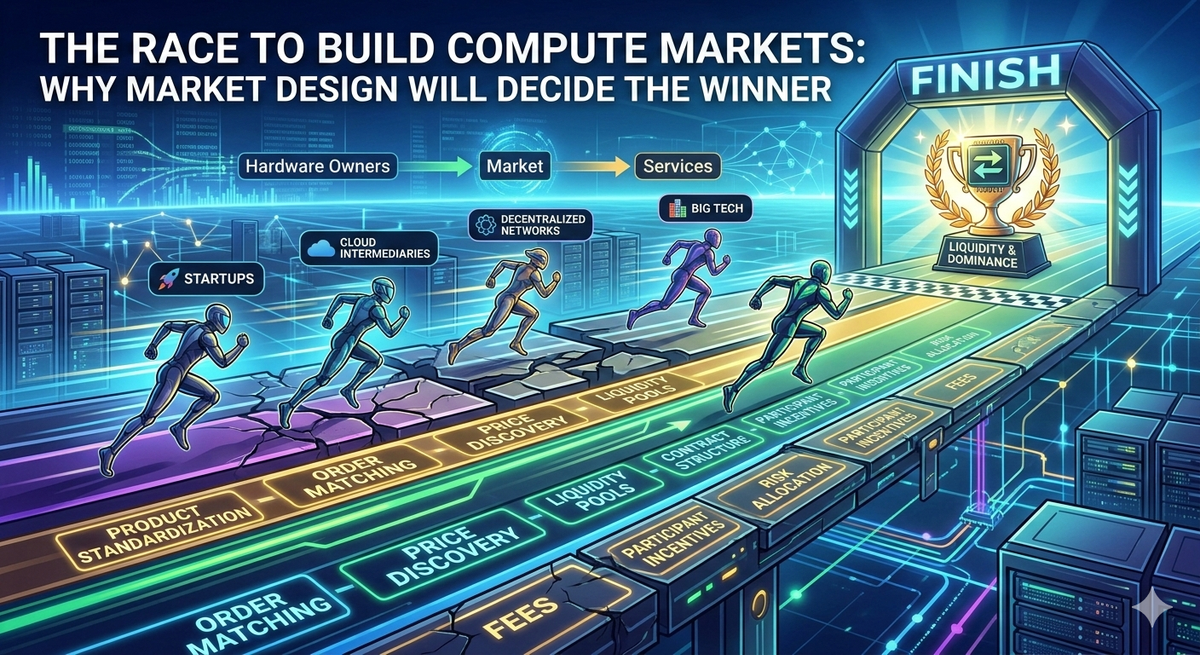
There is a gold rush underway to build marketplaces for compute. Startups and decentralized networks, cloud intermediaries, and new exchanges are all racing to connect hardware owners with users who need GPUs and other accelerated compute.
The prize is enormous: the market that gets the details right will concentrate volume and liquidity, becoming the natural place where compute is bought and sold. However, building a compute market is not simply a matter of launching a platform and waiting for participants to arrive. It is an exercise in purposeful and intentional market design.
Most builders are adapting market designs from other industries — financial exchanges, cloud spot markets, or decentralized token markets — without fully considering whether those designs fit the underlying economics of compute. This is a mistake. Compute is not just another commodity. It is the output of a complex value chain that transforms physical hardware into usable services. The success of a marketplace will be determined by two elements:
1. It’s position in the value chain
2. Its market design elements
The Compute Value Chain: From Hardware to Service
At its foundation, the compute economy begins with hardware owners: those who finance, acquire, and operate GPUs and other infrastructure. But users do not want hardware. They want services—training runs, inference capacity, or reserved compute environments. Between these two endpoints lies a series of economic transformations that convert hardware into something users can consume.

Each step in this value chain changes the product's nature. Raw hardware becomes virtualized capacity. Capacity becomes scheduled workloads. Workloads become guaranteed services with performance and reliability commitments.
At opposite ends of this chain are participants with fundamentally different needs.
Hardware owners require long-term, financeable contracts. Their assets are expensive and long-lived (compared to software runs). To justify investment, they need predictable revenue streams that support financing and reduce utilization risk. Compute users, by contrast, require short-term, predictable access at affordable prices. Their demand fluctuates with product launches, experiments, and customer traffic. They value flexibility, immediacy, and price transparency.
Hyperscalers solve this mismatch through vertical integration. They own the hardware, operate the infrastructure, and sell directly to users. This allows them to manage the economic transformation internally, absorbing risk and reshaping products to meet both sides’ needs.
Marketplaces do not have this luxury. Instead, they must choose where in the value chain to operate.
Choosing the Right Position
This is the single most important strategic decision for any compute marketplace.

Each location in the value chain defines the product being traded and the participants who can participate. A marketplace focused on long-term capacity contracts will attract infrastructure investors and large-scale buyers. A marketplace focused on short-term workloads will attract application developers and operators. These are fundamentally different markets, even though both involve “compute.”
An analogy helps illustrate the point. Zillow and Airbnb both operate in the housing sector. But Zillow is primarily a marketplace for long-term asset transactions, while Airbnb is a marketplace for short-term usage. The product, participants, pricing, and market mechanisms are entirely different. Success in one does not imply success in the other.
Compute marketplaces face the same choice. They must decide whether they are markets for assets, for capacity, or for services. This decision determines everything that follows.
Many current efforts blur these distinctions. They attempt to simultaneously serve hardware owners seeking long-term stability and users seeking short-term flexibility. This creates a structural tension that weakens liquidity and prevents the market from fully serving either side.
The winning marketplaces will resolve this tension by clearly defining their role in the value chain.
Market Design Determines Liquidity
Once a marketplace chooses its position, the second most important decision is to design the market itself.
Market design is not a single choice but a system of interlocking elements. These include, among many, product definition and standardization, order types available to participants, pricing rules, allocation mechanisms, settlement procedures, and the potential role of intermediaries such as market makers.
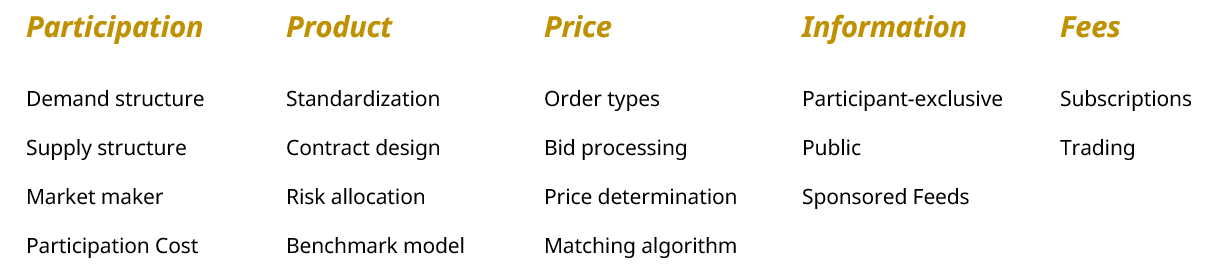
These choices determine how risk is allocated, how prices are discovered, and how easily participants can transact.
Product standardization, for example, has to balance liquidity and basis risk. Highly customized products reduce risk by specifying many operational dimensions but fragment the market. Every design element represents tradeoffs that the market designer must account for.
Most importantly, these elements must be consistent with the marketplace’s position in the value chain. A design that works for short-term service markets will not work for long-term capacity markets, and vice versa.
Liquidity Is the Ultimate Prize
Liquidity is not evenly distributed. Markets tend toward concentration. Participants prefer to trade where other participants already are, creating powerful network effects.
This means that the compute market that gets the details right will not just compete—it will dominate.
But success will not come from copying designs from other industries. It will come from understanding the unique economics of compute. Compute markets are not just technology platforms. They are economic institutions. The builders who recognize this—and design their markets accordingly—will define the future of how compute is bought and sold.