
Spectrum Management for the 21st Century
The Space Modernization NPRM streamlines licensing—and pushes us into a more congested orbital environment. Market-based spectrum management rules are the next logical step.
The FCC’s Space Modernization for the 21st Century NPRM is the most sweeping overhaul of U.S. satellite licensing rules in decades.[1] The proposal replaces Part 25 with a new, modular Part 100 designed for an industry defined by scale, speed, and operational complexity.[2] Several elements of the NPRM are especially relevant for understanding the future of spectrum management.
First, the FCC introduces a “licensing assembly line” built around modular applications and an expedited path for systems that satisfy predefined, presumed-acceptable performance criteria. This framework aims to reduce procedural friction, clarify expectations, and significantly shorten review timelines.[3]
Second, the NPRM would establish rolling annual processing rounds for NGSO FSS applications. Applicants could file at any point during the year, and all eligible applications would be grouped into the same round.[4] In parallel, the FCC proposes an alternative first-come-first-served approach in which each new NGSO FSS filing effectively becomes its own “round,” with technical rules applied sequentially.[5]
Third, the NPRM deepens reliance on the existing spectrum sharing framework, including the ΔT/T thresholds, 1/n band-split backstops,10-year sunset protections, degraded throughput criteria, etc. Most of these rules would be carried over to the newly proposed part 100.[6] Finally, it strengthens information disclosure requirements, including enhanced ephemeris and SSA-related data disclosures.[7]
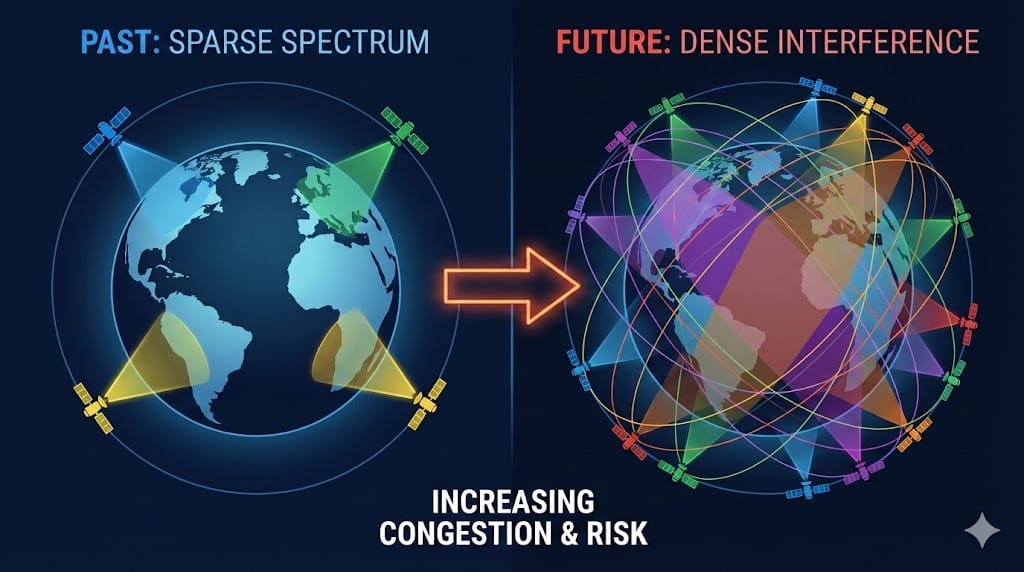
Taken together, these reforms modernize licensing, streamline entry, and move regulatory decision-making toward performance-based criteria. But collectively, they also push the system into precisely the congestion environment where the limitations of engineering-only interference rules become most apparent.[8]
As licensing becomes faster and more predictable, entry costs fall and deployment accelerates, increasing the number of active constellations and earth stations competing for finite spectral resources. The result is higher spectral usage, denser orbital geometries, and increasingly overlapping interference footprints. In this environment, existing sharing mechanisms—such as degraded-throughput thresholds or the 1/n band-split rule— remain effective at preventing catastrophic interference but insufficient for coordinating efficient spectrum use when many systems operate concurrently. Much like road-traffic rules that designate lanes and right-of-way to avoid collisions but do little to relieve congestion, these regulatory backstops secure basic coexistence while leaving the deeper challenges of efficient spectrum allocation unresolved once large-scale entry becomes effectively unconstrained.[9]
However, at the same time, by embracing the existing rules, especially the degraded-throughput methodologies as foundational tools, the NPRM provides the very structure needed for market-based solutions. Once interference is quantified in terms of throughput or availability harm, operators can express preferences through prices, not just filings. Mechanisms such as congestion pricing, EPFD auctions, or compensation for tolerating incremental interference become feasible. Expanded reporting and SSA data strengthen the technical substrate required for these mechanisms.
In short, the NPRM accelerates satellite-sector growth while anchoring regulation in performance metrics that naturally support economic allocation. This combination increases the urgency—and the practicality—of introducing market-based tools to manage interference. The FCC is modernizing space licensing; the next step is modernizing how we allocate and price the interference externalities that accompany that growth.
[1] Space Modernization for the 21st Century, SB Docket No. 25-306, NOTICE OF PROPOSED RULEMAKING, FCC-CIRC2510-01. (Space Modernization NPRM)
[2] Space Modernization NPRM para. 28
[3] Space Modernization NPRM para. 33
[4] Space Modernization NPRM para. 132-133
[5] Space Modernization NPRM para. 145
[6] Space Modernization NPRM para. 140
[7] Space Modernization NPRM para. 212
[8] Lopez, Hector, Market mechanisms for satellite spectrum management (July 30, 2025).
[9] Some of the limitations of the existing rules would be reduced under a first-come-first-served licensing regime, because rules that currently apply only within a processing round would instead operate implicitly at the scale of the entire sequence of entrants. In other words, the current thresholds would effectively determine the “last” system able to enter, thereby fixing the aggregate interference level for all incumbents. Yet this outcome is economically efficient only if the systems that happen to arrive earlier are also those that generate the greatest value for society. In a well-designed system, a high-value entrant should be able to displace or supersede a lower-value incumbent through a mechanism that permits gradual, market-mediated adjustments—such as congestion pricing—rather than relying on the rigidity of temporal priority.